Anker SOLIX C1000 Gen 2: Runtime & Specs
By Hicham M. · Specs from Anker SOLIX's published documents, as of September 2026 · How we calculate
The Anker SOLIX C1000 Gen 2 is a 1,024 Wh LiFePO4 power station with 2,000 W of continuous AC output and a 3,000 W surge rating. It runs a typical full-size fridge for about 15 hours.
We may earn a commission if you buy through these links. It never changes our numbers, and every model in our database is included whether or not it pays us. Learn more.
Simulated runtimes (not measured)
Nobody tested this unit for this page. These figures come from a computer simulation of the C1000 Gen 2, and they are estimates. The plain runtime table below divides energy by average draw at 85% efficiency. The simulation also charges the battery for the power the inverter burns just by being switched on, which is why small loads come out shorter. Where we have measured a unit, the measurement is shown separately and labeled as measured.
| Device | Spec-sheet math | Simulated, typical | Likely range | Simulated at 0 °C |
|---|---|---|---|---|
| Wi-Fi router + modem | 2.4 days | 26 hours | 22 hours to 32 hours | 22 hours |
| CPAP (no humidifier) | 29 hours | 19 hours | 16 hours to 21 hours | 16 hours |
| Starlink Standard | 9.7 hours | 8.4 hours | 7.9 hours to 9 hours | 7.1 hours |
| Refrigerator (full-size, ENERGY STAR) | 15 hours | 12 hours | 11 hours to 13 hours | 10 hours |
Nonstop runtime from full to battery cutoff. Likely range = middle 80% of 200 simulated runs with the uncertain inputs varied. The inverter idle draw is assumed, not published: we assumed about 20 W for this model, varied from 12 to 30 W. If the real figure is lower, real runtimes land closer to the spec-sheet column.
How this was simulated
- The battery is stepped down every 2 minutes until it reaches cutoff, for 200 runs per device. Results are seeded, so the page shows the same numbers on every build.
- Battery draw = load + inverter idle draw + 4–8% of the load + a loss that rises with load squared (4% at full output).
- Usable capacity = 92–98% of rated Wh, for protection cutoff and aging.
- At 0 °C, 80–90% of that capacity is assumed available.
- Fridges cycle on and off every 30–50 minutes at the share of the time set by their average draw. The inverter idle draw continues while the compressor is off.
- Devices that exceed this model's output or surge rating are left out. Loads are US 120 V devices.
These ranges are assumptions about a typical unit. They are not manufacturer figures for the Anker SOLIX C1000 Gen 2. How we calculate · How we use AI
How long will the C1000 Gen 2 run your appliances?
Nonstop runtime for one device at a time, using typical US wattages and 85% inverter efficiency. Devices marked ✕ can't run on this model.
| Device | Avg draw | Runtime | Bar |
|---|---|---|---|
| LED light bulb | 9 W | 4 days | |
| Phone charging | 10 W | 3.8 days | |
| Wi-Fi router + modem | 15 W | 2.4 days | |
| Laptop | 50 W | 17 hours | |
| CPAP (no humidifier) | 30 W | 29 hours | |
| CPAP with heated humidifier | 60 W | 15 hours | |
| Starlink Standard | 90 W | 9.7 hours | |
| TV | 100 W | 8.7 hours | |
| Mini fridge | 29 W | 30 hours | |
| Refrigerator | 58 W | 15 hours | |
| Chest freezer | 29 W | 30 hours | |
| Sump pump (1/3 HP) | 160 W | 5.4 hours | |
| Sump pump (1/2 HP) | 210 W | 4.1 hours | |
| Window AC | 225 W | 3.9 hours | |
| Drip coffee maker | 1,000 W | 52 min | |
| Microwave | 1,500 W | 35 min | |
| Space heater | 750 W | 1.2 hours | |
| Well pump | 33 W | Needs 240 V |
Fridges, freezers, pumps and AC units cycle on and off, so we use their average draw. Want a mix of devices on a schedule? Use the runtime calculator.
The C1000 Gen 2 in action
Anker SOLIX's own video, so expect a sales pitch. It loads from YouTube only when you press play.
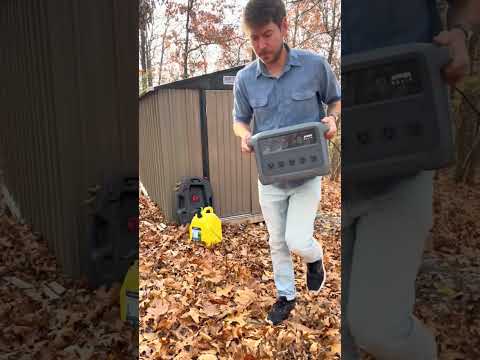 Play the Anker SOLIX C1000 Gen 2 video: Anker SOLIX C1000 Gen 2 | Reliable Power for Your Outdoor Setup
What the C1000 Gen 2 can't power
- Well pump (1/2 HP submersible): needs 240 V
Solar charging time
Hours of good sun to charge from empty, assuming panels deliver 75% of their rating.
| Panels | Power in | Hours of sun |
|---|---|---|
| 100 W of panels | 75 W | 14 hours |
| 200 W of panels | 150 W | 6.8 hours |
| 400 W of panels | 300 W | 3.4 hours |
| 600 W of panels | 450 W | 2.3 hours |
Check panel voltage and wiring with the solar charging calculator.
Full specifications
| Battery capacity | 1,024 Wh |
|---|---|
| Amp-hours at 12 V (converted) How we convert | 85.3 Ah (80 Ah at 12.8 V) |
| Battery chemistry LFP vs NMC | LiFePO4 (LFP) |
| Continuous AC output | 2,000 W |
| Surge (peak) output | 3,000 W |
| Boost mode | None listed |
| AC voltage | 120V |
| AC outlets | — |
| USB-C ports | 3 (up to 140 W) |
| USB-A ports | 1 |
| 12 V car outlet | Yes |
| Max solar input | 600 W |
| Solar voltage range | 11–60 V |
| Solar max current | 14.5 A |
| Max AC charging power | 1,600 W |
| AC charging time (maker claim) | 100% in 49 min (UltraFast, 1,600W) |
| Expandable | No |
| UPS / EPS switchover What this means | 10 ms |
| Cycle life What this means | 4,000 cycles |
| Weight | 24.9 lb |
| Warranty | 5 years |
Notes: Model A1763. AC outlet count not published: Anker says '10 ports'; manual lists 3 USB-C (140/140/15W), 1 USB-A, 1 car socket. 1,200W standard AC charging. Not expandable.
Specs from Anker SOLIX's published documents, as of September 2026. Found an error? Tell us.
Sources
Similar power stations
- C1000 Gen 2 vs EcoFlow DELTA 3
- C1000 Gen 2 vs EcoFlow DELTA 3 Plus
- C1000 Gen 2 vs BLUETTI Elite 100 V2
- C1000 Gen 2 vs DJI Power 1000
- C1000 Gen 2 vs Goal Zero Yeti 1000
- C1000 Gen 2 vs Anker SOLIX C1000